Saturday, 4 February 2023

National Ombudsman Recommended for Retirement Villages

The Australian Urban Research Institute has recommended a National Ombudsman for Retirement Villages. 

Retirement Villages in Australia operate under varying laws of the State Governments, this as opposed to aged care facilities that operate under Commonwealth laws. 

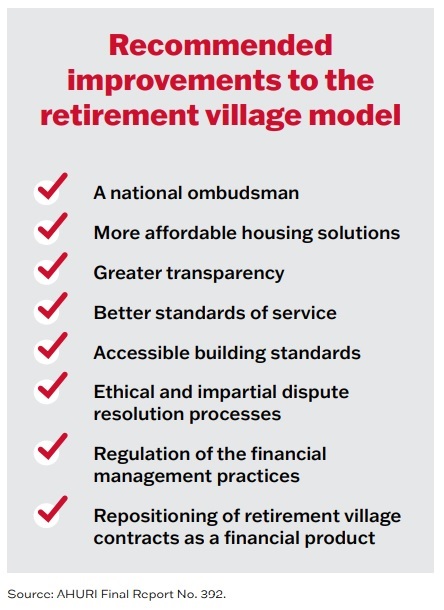
AURI published a report on the industry in December 2022, the primary recommendations of the report were - 

  • A national ombudsman
  • More affordable housing solutions
  • Greater transparency
  • Better standards of service
  • Accessible building standards
  • Ethical and impartial dispute resolution processes
  • Regulation of the financial management processes
  • Repositioning of retirement village contracts as a financial product
The AURI report titled Business models, consumer experiences and regulation of retirement villages can be found via this link - https://www.ahuri.edu.au/research/final-reports/392 


Monday, 25 April 2022

Danger in Retirement Village Resident Fees


Evidence for many residents in retirement villages shows they are being taken advantage of for items in their units where they are arbitrarily being made responsible to pay for repair and/or replacement.

Retirement Villages come under Victorian law whereas aged care facilities come under commonwealth law. Regulation 11(1h) under Victorian law requires a village operator to list the relevant fixtures, fittings and furnishings in the contract before the contract is signed. 

A resident in a Victorian retirement village paying for repair or replacement of fixtures, fittings or furnishings not listed in your contract? Seek advice now from a local free legal advice service, your solicitor or Consumer Affairs. 

Currently the Retirement Villages Act 1986 is under review by the State Government, if this matter is applicable to you or there is another matter of concern to you make those concerns known to your local State Government representative.

Find you local state government representatives - https://www.parliament.vic.gov.au/about/people-in-parliament/members-search/search-members


Friday, 8 April 2022

RRVV Refreshes Member Website

The peak representative body for retirement village residents in Victoria, Residents of Retirement Villages Victoria has refreshed their web site with a bold new look.
Residents of Retirement Villages Victoria Inc. is an independent volunteer organisation serving and representing residents of retirement villages and similar housing communities within Victoria. RRVV as they are commonly referred to represent around 6,000 residents and growing.
The organisation is member-based and is managed by a committee of unpaid volunteer village residents who are elected annually at their Annual General Meeting. They do not receive any government funding and depend solely on fee subscriptions and member donations to operate.
New members are always welcome as the more members they have, the greater is their effectiveness, they encourage all retirement village residents to join as this will support all residents of retirement villages across Victoria. 
Take this link to their 'new look' web site - Residents of Retirement Villages Victoria

Sunday, 20 March 2022

Retirement Villages = 'The transfer on intergenerational wealth'

 Retirement Villages = 'The transfer on intergenerational wealth, not to families, but into the hands of corporations. Shame about elderly people not having enough money for Aged Care.' - Tom Gait


Wednesday, 16 March 2022

Capital Gains - Retirement Village Units Perform Poorly

More evidence retirees get better financial results by staying in the family home and seeking a home care package than moving into a retirement village unit.

An article at The Weekly Source shows that retirement villages have taken  the last 5 years to reach a 22% increase in value whereas the family home has done that in just the last year.

Note - Industry data shows only 37% of new retirement village occupancy contracts offer an incoming resident a share of any increase in the value of the unit.

The full article can be read here - https://www.theweeklysource.com.au/in-five-years-village-home-prices-increased-by-22-vs-22-in-one-year-for-residential-prices-is-this-a-shame-on-village-marketers/ 

Wednesday, 9 March 2022

Retirement Village 6 Month Payout Rule Madness

Victorian loan/lease retirement village residents are trapped in a legislation nightmare. They may never get their money back on leaving a loan/lease retirement village if the unit in which they resided is not re occupied. Hard to believe but this is current Victorian state government legislation, legislation overseen by the Minister for Consumer. There are real life examples of retirees, their estates or their families that are still waiting over 4 years now for their money as a result of village unit sales slowing or in fact stopped. Incredibly they may never get their money back unless Victorian retirement village laws are changed.

The original law was changed so that village operators could place certain clauses in occupancy contracts. Clauses that allowed residents the option, note the option, to participate in the selection of a selling agent and in some cases the setting of a new lease price for the unit they once occupied but did not own. The impact of this on the outgoing resident is the removal of the 6 month maximum period payout rule, incredibly this happens whether an outgoing resident chooses to actively participate in the re leasing of their unit or not. What happens if the unit never gets a new lessee, there is no statutory or contractual obligation on the operator to ever repay them their refundable money. This could range of course from a few hundred thousand dollars to over a million dollars, all because of a piece of poorly drafted legislation.

The mere action of the village operator putting these Regulation 6 Schedule 1 or Schedule 2 clause in the contract negates the 6 month payout rule. Why would a loan/lease retirement village resident knowingly give up a maximum repayment period of 6 months in exchange for absolutely no limit at all. Such is the complexity of retirement village contracts that this is happening every day, contracts are continually signed without a clear understanding of what is in the document.

The Minister responsible to oversee Retirement Village law has the power to fix this. The power to return the six month rule to at least those retirees who do not or did not want to participate in 1. the process of selecting the selling agent and 2. in some circumstances the setting of the new village ingoing price for that unit.

Friday, 11 February 2022

Retirement Villages - State Governments Know The Core Problems

When it came to retirement villages the Victorian governments have known of the primary problems as far back as 2004. Successive governments since 2004 have failed to act to correct the resident owner/operator imbalance.

The following are excerpts from the 2004 state government report into retirement villages. They identified the core issues but those issues are still as relevant today as they were back then.

Nothing has really changed.

“Possible negative consequences for residents and prospective residents are also increased because of the effects of age-related characteristics on their ability to make informed and knowledgeable decisions about retirement village services.”

“Secondary markets that respond to the complex information requirements of the retirement village market (solicitors, financial planners, accountants and the like) have not developed to a level which adequately respond to market need. Consequently, the potential for consumer detriment is enhanced.”

” A considerable number of submission to the review raised concerns about the potential for financial loss when residents exit a village. Contracts that respond to the range of legal structures, services, facilities and fee are complex and residents find them difficult to understand. The problem is compounded by the large proportion of residents who are making a one-off decision, of significant financial nature, to enter a retirement village. Many of the legal and fee arrangements they must consider are unfamiliar to them and information and advice to help them make an informed decision appears to be limited.”

“Analysis of the retirement village market has revealed evidence for potential substantial consumer detriment arising from information asymmetry – the position where village owner/operators have superior knowledge of the services provided than do prospective residents.”

All this published in a Victorian state government report on retirement villages way back in 2004.


Wednesday, 9 February 2022

Finance Contracts - Retirement Villages The Most Complicated

 In a stinging critique Michael West Media exposes retirement village contracts as -

"the most complicated finance contracts in Australia"

The article exposes these contracts as "So devilishly complicated are retirement village contracts that an actuary and lecturer in applied finance, someone at the very pinnacle of mathematics and structured finance, reckons they are harder to understand than even synthetic collateralised debt obligations (CDOs)." 

The video below shows these retirement village contracts, which can stretch up to 500 pages, bewildered all but one of 20 university-educated, retiree-aged subjects in a 2020 study into the financial literacy of consumers looking to enter into retirement village contracts.

Retirement Village contracts - "the most complicated finance contracts in Australia"

The full article can be read here - https://www.michaelwest.com.au/retirement-villages-the-most-complicated-finance-contracts-in-australia/ 

Saturday, 5 February 2022

Michael West Retiree Capital Destruction

Well respected independent media Michael West Media have published a strong article as to how occupancy in a loan/lease retirement village destroys retiree capital over the period of their occupancy, as opposed to staying in the family home.

Take the link to read the article - https://www.michaelwest.com.au/retirement-villages-the-destruction-of-retiree-capital/

Saturday, 15 January 2022

Retirement Villages & Destruction of Retiree Capital

 Retirement Villages and the Destruction of Retiree Capital

A primary feature of Loan/Lease Retirement Villages (74% of the marketplace) is that despite the payment of an ingoing amount, an amount often commensurate with or near to an outright purchase price, the retiree never obtains ownership. Note below the dramatic negative financial impact this aspect has on retiree capital as opposed to outright property ownership. Retirement villages are the least understood of residential property by retirees and their professional advisors. Governments have the obligation to continually improve protections for retirees and their hard earned life savings, including those who choose a retirement village as their preferred retirement living option. The solution is clearly in an outright property ownership model.

Model 1. Loan/Lease retirement village with Deferred Management Fee calculated on the ingoing value of the unit. No share of any capital gain is provided to the retiree.  (49% of loan/lease marketplace)           

  1. Industry average occupancy period 7 years                                                               
  2. Retirement Village Living over 7 Year Lease Period                                                   
  3. Retiree Capital = $800,000.00                                                                                      
  4. Ingoing Payment/Loan to Operator = $800,000.00                                                      
  5. Deferred Management Fee of 36% on the unit ingoing amount = $288.000.00 (6%pa over first 6 years)          
  6. 5% Sinking Fund Contribution on the unit ingoing amount = $40,000.00                      
  7. Retiree Capital Cost = -$328,000.00                                                                            
  8. Resident Refundable before any exit costs after 7 years = $472,000.00                                            
  9. Unit Value after 7 years = $1,194,983.00                                                                   
  10. Capital Gain at 5.9%pa to Operator = $394,983.00.00                                                              
After just 7 years the above Loan/Lease retirement village resident is $1,194,983.00 – $472,000.00 = $722,983.00 worse off than a retiree with outright property ownership. A reduction rate of some $1,984.56 per week of village occupancy.                  

Model 2. Loan/Lease retirement village with Deferred Management Fee (DMF) calculated on the outgoing value of the unit. A share of any capital gain is provided to the retiree. (51% of loan/lease marketplace)                                                      
  1. Industry average occupancy period 7 years                                                               
  2. Retirement Village Living over 7 Year Lease Period                                                   
  3. Retiree Capital = $800,000.00                                                                                      
  4. Ingoing Payment/Loan to Operator = $800,000.00                                                      
  5. Deferred Management Fee of 36% on the unit outgoing value = $430,194.00 (6%pa over first 6 years)          
  6. 5% Sinking Fund Contribution on the unit outgoing value = $59,749.00                      
  7. Retiree Capital Cost = -$489,943.00    
  8. Unit Value after 7 years = $1,194,983.00
  9. Capital Gain at 5.9%pa = $394,983.00.00 - (Net Capital Gain to Retiree 64%  = $252,789.00) - (Net Capital Gain to Landlord 36%  = $142,194.00                                              
  10. Resident Refundable before any exit costs after 7 years = $705,040.00                                            

After just 7 years the above Loan/Lease retirement village resident i$1,194,983.00 – $705,040.00 = $489,943.00 worse off than a retiree with outright property ownership. A reduction rate rate of some $1,346.00 per week of village occupancy.

Model 3. Outright Property Ownership - Well understood by retirees and their professional advisors.          

  1. Outright Property Ownership over 7 years  
  2. Retiree Capital = $800,000.00                                                                                      
  3. Ingoing Payment/Loan to Operator = $800,000.00                                                      
  4. Deferred Management Fee = n/a          
  5. Unit/Home Value after 7 years = $1,194,983.00
  6. Capital Gain at 5.9%pa to Retiree = $394,983.00                                            
  7. Retiree Capital after 7 years = $1,194,983.00
  8. Retiree Capital Increase = +$394,983.00
After just 7 years the above Retiree is $1,194,983.00 – $800,000.00 = $394,983.00 better off through outright property ownership. An increase rate of some $1,085.11 per week of occupancy.

Property ownership delivers superior financial security to retirees, it enables them to -     

  • Move to another retirement living property by maintaining pace with rising property values. 
  • Better fund their own Aged Care requirements rather than the taxpayer.                               
  • Enable a higher allocation of funds to family/beneficiaries.                                     
  • Enables access to the Federal Government Home Equity Scheme, denied to them by loan/lease retirement village occupancy.

Real retirement village reform is desperately needed before many, many more retirees are condemned to the destruction of their life savings. Destruction over just a few years of their retirement by a single fateful decision, a decision to enter a loan/lease retirement village.

Families need to be aware that what we are talking about here is the transfer of intergenerational wealth, not to families, but into the pockets of corporations. Shame about elderly people not having enough money for aged care” – Tom Galt, President – NSW Retirement Village Residents Association.

Which retirement living model would you choose?

  1. -$722,983.00 – 7 years of occupancy in a Loan/Lease Retirement Village no capital gain

  2. -$489,943.00 – 7 years of occupancy in a Loan/Lease Retirement Village with capital gain

  3. +$394,983.00 7 years of occupancy with Outright Property Ownership


Note – The tables behind these calculations are included below for reference.  

  • Industry Data shows average occupancy period in a retirement village is between 7 and 8 years.
  • Corelogic data shows last 25 years residential housing capital gain rates at 8.1%, units 6.6%.  
  • Industry Data shows only 16 per cent of retirement village units are occupied on a freehold basis.
  • Industry data shows unit prices increased by 5.9% per annum over the last 25 years.

Model 1 - Loan/Lease retirement village with Deferred Management Fee calculated on the ingoing value of the unit. No share of capital gain to retiree.

retirement village destruction of retiree capital table 1


Model 2 - Loan/Lease retirement village with Deferred Management Fee (DMF) calculated on the outgoing value of the unit. Share of capital gain is provided to the retiree.

table 2 retirement village destruction of retiree capital


Function of Government

The role of government is to create an environment for commerce to function whilst at the same time protecting retirees and particularly vulnerable retirees from both financial and emotional harm emanating from that function.

The Victorian Retirement Villages Act 1986 provides the environment for commerce to function but fails to fully protect retirees from financial and emotional harm as a result of it.

The Victorian legislative definition of a retirement village in demanding the payment of an 'in-going' amount without the transfer of property ownership is a major contributor to that financial and emotional harm suffered by retirees.


retvill.net

Popular Posts

Labels